"Early Electric! Maybe even here They met that evening at six-fifteen Beneath the hearts of this electrolier And caught the first non-stop to Willesden Green, Then out and on, through rural Rayner's Lane To autumn-scented Middlesex again." John Betjeman (The Metropolitan Railway, 1954)
To commemorate the centenary of Sir John Betjeman's birth, I've been back to the locations that he visited in his classic 1973 documentary Metro-land.
Calling at...
BAKER STREET
MOOR PARK
MARLBOROUGH ROAD
CROXLEY
NEASDEN
CHORLEYWOOD
WEMBLEY PARK
AMERSHAM
HARROW-ON-THE-HILL
QUAINTON ROAD
PINNER
VERNEY JUNCTION
• Read the whole series on one page (in the right order) here. • See where all my Metro-land photographs were taken here.
"The houses of Metro-land never got as far as Verney Junction. Grass triumphs, and I must say I'm rather glad" John Betjeman at Verney Junction ("Metro-land", BBC, 1973)
The farthest outpost of the Metropolitan Railway is at a most unlikely spot. The line ended not in a town, nor in a village, nor even in a hamlet, but in the middle of a field. There was no local population to support a station, nor any intention of building commuter homes across the landscape to create passenger traffic. But there was an existing railway passing through - the mainline connecting Oxford to Cambridge - so it sort of made commercial sense to link up to that. But only sort of. A couple of platforms were built where the two lines met, linked to the outside world down a dirt track, with the intention that everyone would both arrive and depart by train. The station was named Verney Junction after local landowner Lord Verney (Florence Nightingale's brother-in-law) who was chairman of the local railway company. And trains passed through, and passengers passed through, and life passed by.
In 1936 the Met's rural branch lines were finally amputated. It was no longer possible to catch a train from Verney Junction to Baker Street, but you could still travel from here to either Oxford or Cambridge. This was until Oxbridge travellers discovered that travelling into London and back out again was faster than chugging painfully slowly cross-country, and so the through route duly closed to passengers at the end of 1967. Verney Junction is now your actual genuine abandoned railway station, sitting invitingly on the map awaiting a bloke with a camera. I took up the challenge and attempted a visit (which isn't easy when there are no trains).
Verney Junction is now just the name of a tiny hamlet which grew up around the station (at a rate of about one building every decade, by the looks of it). Turn off the road at the Verney Arms pub and, a short distance down an unmade track, there's a sign for a railway crossing. An anachronistic red sign asks you to Stop Look Listen, and to notify the local British Rail Manager if your load is unusually long. But the crossing gates have disappeared, the rails across the lane are barely visible, and any danger is long past [photo]. To your right, the other side of some thickening undergrowth, you can walk along the ballast in the general direction of Cambridge [photo]. And immediately to your left the main attraction - two abandoned platforms blanketed beneath a low covering of green foliage [photo]. I guess midsummer isn't the best time to come here for a decent view.
Only a single track runs through Verney Junction today, supported by slowly rusting brackets and gently rotting sleepers. The rails at the far end of the station heading away towards Oxford look relatively navigable, so long as you're on foot [photo]. But between the platforms themselves somebody has planted a loco's-length forest of yellowish saplings [photo], either to block the upline or to beautify the view from the old station house nextdoor [photo]. Elsewhere nature is successfully reclaiming the deserted station unaided. You can barely walk on any of the original platforms now that bracken, bushes and brambles have colonised both surfaces [photo]. But try to find a space and climb up here, to stand where passengers once waited to board the next steaming train to the capital. Glance across to the opposite platform while you still can [photo]. And then take a look out across the empty fields [photo], past the cattle [photo], towards the grand future that never materialised. London could never claim this tranquil spot for its own, but this will be forever Metro-land.
Metro-land revisited The Buckinghamshire Railway Centre Quainton Road
The Metropolitan Railway had ideas well above its station. In the 1880s there were plans to boost traffic by linking London to places far outside the commuter hinterland - cities such as Oxford and Manchester. By buying up a failed railway company they reached out as far as the grassy plains of the Vale of Aylesbury, nearly halfway to Birmingham. And at Quainton Road, down an obscure uninhabited country lane, the company established its bridgehead. Here the tracks split, with one branch steaming north [photo] to Verney Junction, the other west [photo] to the hilltop village of Brill. But the railway artfully skirted even the smallest centres of population so there was very little passenger traffic, and the express trains to the Midlands never materialised. When London Transport took over the Metropolitan in 1933 they had no interest in running rural Buckinghamshire services and so retreated to Aylesbury, and later 20 miles further back to Amersham. When Betjeman came to Quainton Road in 1972 he found just a footbridge between deserted platforms, and a rarely-used goods line stretching off into nowhere.
The view from the footbridge at Quainton Road is quite different today [photos]. Look down the line and you'll see a second (wheelchair accessible) metal footbridge, several well-preserved buildings and maybe even people waiting for trains. That's because the site has been taken over by the Buckinghamshire Railway Centre - one of those dark, sooty places where grown men come to play with steam engines. There's everything you'd expect - a picturesque station [photos], a museum in a Nissen hut, a tea room, and several sidings full of engines and carriages in various states of restoration. And on special days (like this last bank holiday) the centre runs an hourly diesel service down to Aylesbury, oh-so-briefly reconnecting Quainton Road to the main rail network. On Betjeman's birthday I took a rare opportunity to ride out and take a look.
Two steam locomotives were in operation, one still resplendent in Metropolitan livery [photo]. Visitors were treated to a quarter of a mile ride down the track for a view of some cows in a field, and back again, and back again, and back again [photo]. To make the trip in any way memorable you had to sit in the front carriage, right behind the smoking engine, else you could have been aboard any timewarped train on a return journey to nowhere. Two other scales of locomotive were available, courtesy of the Vale of Aylesbury Model Engineering Society. The medium sized trains were for sitting astride and then being chugged round a small twisty circuit (perfect for keeping keen kids of all ages occupied) [photo]. The smaller sized trains were radio controlled and went round and round in circles on a plywood platform until you got tired of watching. In the nearby picnic area members of the society jostled to buy spanners and oily metal bits from a small kiosk, while visitors treated themselves to individually cling-filmed slices of battenburg to eat alongside a polystyrene cup of steaming tea.
Outside the gift shop a fairground organ played repeatedly, as grating as a ringtone but impossible to switch off. Two volunteers in smart black uniforms guarded the entrance to the downline platform lest any miscreant try entering without having their ticket clipped. Some of the day's visitors spent their time rifling through railway ephemera, others were intent on capturing the perfect shot of a train or two puffing by, but most were content to wander from attraction to attraction in a nostalgic haze. As an extra incentive this weekend, the centre had laid on a Vintage Vehicle Show in the car park. Scores of gleaming motorbikes and a few scooters revved in through the gates and parked up beside a gaggle of US army jeeps. Motorists with Morgans and Morris Minors sat and unwrapped tinfoil sandwiches behind their open boot, then stood around and compared hub caps and radiators with fellow enthusiasts. The road and rail crowd mixed fleetingly, then returned to be with their own kind.
For a brief moment it was just about possible to imagine this old railway junction as the hub of a mighty Metropolitan empire, with the Manchester Express pulling in on one platform to exchange passengers with the Oxford Pullman on another [photo]. But one look out from the footbridge, across acres of empty pasture towards far distant villages, told a very different story [photo]. This station was never meant to be the Clapham Junction of the south Midlands. Quainton Road was always destined to be a museum piece - the pipedream of men playing with trains - and its current destiny suits the place just perfectly.
"In those wet fields the railway didn't pay. The Metro stops at Amersham today." John Betjeman at Quainton Road ("Metro-land", BBC, 1973)
"Steam took us onwards through the ripening fields ripe for development where the landscape yields clay for warm brick, timber for post and rail through Amersham for Aylesbury and the Vale." John Betjeman at Amersham ("Metro-land", BBC, 1973)
No other 'Underground' line reaches as far out into the Home Counties as the Metropolitan [photos]. The railway's ambition extended up the Chess Valley to Chesham and Amersham, more than 25 miles (but still less than an hour) from central London. But the landowners of ancient Amersham didn't want new-fangled rail scarring their stately views, and so forced the tracks to pass to the north of the old town. And that's why there are now two Amershams - one old beauty in the valley and one new suburb on the hill.
Old Amersham is a genuine throwback to the past - a well-preserved coaching town situated one day's ride out of London. The broad High Street is lined by a hotchpotch of antique buildings, many dating back to Tudor times. Cottages and coaching inns jostle with inglenooked townhouses and half-timbered terraces - precisely the olde worlde architecture that the remainder of Metro-land seeks to emulate. At one end is the turreted Market Hall[photo], once bustling every Tuesday with traders, but all that I found beneath its brick arches was a bored lady failing to sell leather handbags to a trickle of passers-by. If you've ever seen Four Weddings and a Funeral then you'll have seen the crooked exterior of the King's Arms Hotel [photo], and also the interior of The Crown. This really is picture postcard stuff - or would be were it not for the cars parked absolutely everywhere. So wide is this historic High Street that rows of vehicles are parked not just along each edge but also down the middle of the road. Every tourist who arrives by car corrupts the very scene that they have come to view [photo].
But Betjeman came not to see the old town, nor the model dormitory town on the hill, but the one jarring architectural note struck between the two. In 1929, on what was then a bare hillside above the River Misbourne, was built the startling white Y-shaped house which "scandalised Buckinghamshire". High and Over was Britain's first Modernist home, based on the architecture of Le Corbusier, with three wings radiating from a central hexagonal hall. The first owner was university professor Brian Ashmole, later director of the British Museum, who moved in despite vehement local opposition (1929 cost £3000). In 1962 the house was divided in two, partly to stave off the threat of demolition, but the place is considerably more desirable today. High and Over is now the sort of special property which the Times and Daily Telegraph run a double-page feature about every time it goes on the market (2003 guide price £675000; 2005 guide price £995000). Be jealous, be very very jealous.
High and Over is much harder to spot these days. Trees have grown up on all sides, so you now have to approach rather closer to get a half-decent view. Just up from Tesco, along Station Road, turn off up the hill into the cul-de-sac called Highover Park. Two more bright white houses guard the entrance, tall and sleek like neighbouring pavilions at a 1930s lido [photos]. These are the "Sun Houses" [photos], built in the shadow of High and Over and equally shocking in their day. A third Sun House nestles in woodland further up the close, resembling the top of a submerged ocean liner [photo]. Keep climbing, trying not to be disappointed by the surrounding development of some very ordinary 70s residential infill. And there to your right, down a high-hedged driveway, is a narrow glimpse of High & Over[photo]. From the pavement you can only see one 120 degree segment, with barely-windowed white walls leading up to a second floor roof terrace. Two pert conifers stand guard by the front door, behind a low dribbly fountain surrounded by a swoosh of gravel. And that brown and white lump to the right is the family hound, who by now will have woken up and intends to bark urgently until you withdraw. High time you were leaving. Over and out.
"Goodbye High hopes, and Over-confidence." John Betjeman at High & Over ("Metro-land", BBC, 1973)
"Large uneventful fields of dairy farm, slowly winds the Chess, brim full of trout, an unregarded part of Herts awaits its fate. And in the heights above, Chorley Wood Village - where in 89 the railway came, and woodsmoke mingled with the sulphur fumes and people now could catch the early train to London, and be home just after tea." John Betjeman at Chorleywood ("Metro-land", BBC, 1973)
Betjeman described Chorleywood as "quintessential Metro-land", and it still is. Here, beside the border to beechy Bucks, London's wealthier commuters found themselves a new home in the Chiltern foothills. Lucky them. The place retains a leafy rural air to this day and, in a recent Government survey, beat 32481 other locations to be named the neighbourhood with the UK's highest quality of life. Chorleywood has proper shops with hanging baskets, and cricket on the common, and a picturesque river valley, and league-topping schools, and very little in the way of crime. The village is quartered by the M25 [photo] and the Metropolitan railway [photos] - a short drive round to Heathrow or just three-quarters of an hour down to the City. Easy to escape from, but even easier to bolt home to.
From the station I set off south in search of Sir John's first quarry, a house up Shire Lane named "The Orchard". Here the architect CharlesVoysey built himself a ground-breaking home in cottage style - with steeply pitched roofs, bold chimneys, high eaves and the occasional porthole window. Betjeman found the place without any problem, but I had only a postcode to guide me. A steep climb beneath tree-capped skies led me into the heart of the Chorleywood estate, past grand detached homes each with a seven-digit "guide price". Two jodphured girls trotted past on horseback, while the heavily-laden local paperboy trudged repeatedly up and down consecutive driveways delivering his stash of Mails, FTs and Telegraphs. As in so much of Metro-land, many houses appeared to be named after the rural feature they had replaced - "Beechcroft", "Oakland", "Glenwood". But nowhere "The Orchard", which hid stubbornly from view behind some unidentified hedge. There's a limit to how long you can spend hanging around a Neighbourhood Watch area, camera in hand, before starting to feel uncomfortable. After the second twitch of a net curtain I abandoned my search and retreated back down the hill, closely followed by two speeding police cars. No wonder the crime rate round here is virtually nil.
"Oh happy outdoor life in Chorleywood in Daddy's swim pool, while old Spot looks on and Susan dreams of super summer hols whilst chlorinated wavelets brush the banks." John Betjeman at Chorleywood ("Metro-land", BBC, 1973)
On the other side of the railway lies ChorleywoodCommon[photos], 200 acres of former grazing land now shared by horseriders, golfers and great crested newts. I braved the roaming dogs and rambled from the station to the cricket ground, only mildly yapped-at along the way. Beyond the motorway I came, like Betjeman, to the exclusive Loudwater estate. The first houses here sold (slowly) for £1300 a time - now they cost a thousand times more and the residents have retreated behind iron gates to protect their investment. I followed signs for the Chess Valley Walk, which on paper looked like a charming stroll beside a rippling trout stream, but turned out instead to be a hemmed-in footpath down a canyon of wooden fences. Occasionally the sweeping back gardens of Loudwater were clearly visible, their pools and paid-for privacy invaded by a public right of way.
At last the houses faded away and the path opened out into the corn-gold Chess Valley. All was silent, bar the buzzing of a few indistinct insects and the cooing of a distant pigeon. I slowed as a curious rabbit hopped patiently along the path in front of me, but a startled green woodpecker seemed in more of a hurry to get away. After half a mile I reached the flat wooden footbridge [photo] where I'd often come as a child to paddle in the shallow waters and fish for tiddlers using a small net on a stick. Thistledown floated into the sky as as butterflies and dragonflies darted across the surface of the stream. Back in the 70s the riverbank used to be packed every weekend with picnicking families but on my visit, mid-afternoon on a sunny summer Sunday, it was nigh empty [photo]. Where have all the children gone? I guess today's Chorleywood kids prefer to be sat at home X-boxing instead, or else have been dragged off to some crowded Mediterranean beach to learn how to waterski. But I'm glad that this spot still survives intact and unspoilt, and that not all of Metro-land has been destroyed beneath a carpet of brick, lawn and concrete.
Metro-land revisited The Croxley Green Revels Croxley
And then Sir John came to my home village. You can imagine my surprise on watching Metro-land for the very first time to see my own insignificant commuter backwater celebrated on screen. Here were roads I walked down and events I attended and even people I knew, immortalised on film, watched by millions. But surely there was nothing in CroxleyGreen worthy of Betjeman's scrutiny? This was just another dormitory suburb [photo] on the Metropolitan railway [photos], overshadowed by neighbouring Watford and Rickmansworth. Why would anybody find my life interesting?
If I'd been making a documentary about Croxley Green I might have visited the big house on New Road where Madame Tussaud sculpted her waxworks, and in whose former studio I attended nursery school. Or I might have headed down to the canalside where the John Dickinson paper mill manufactured world-famous Croxley Script watermarked notepaper [photo]. Maybe even gone to the converted farm at the top of my road where barking Barbara Woodhouse trained dogs her way. But no, Sir John selected instead the village's annual carnival - the Croxley Green Revels - and delighted in its muted self-importance.
"Onward, onwards, north of the border, down Hertfordshire way. The Croxley Green Revels - a tradition that stretches back to 1952. For pageantry is deep in all our hearts and this, for many a girl, is her greatest day" John Betjeman at Croxley Green ("Metro-land", BBC, 1973)
One Saturday every summer, as in a thousand other villages across the country, the good people of Croxley Green came together in a festive celebration of community. Some decorated the backs of lorries with crepe paper and sat on the back dressed as cannibals, or hula dancers (or something else typically English) while others twirled batons and paraded along behind. The rest of us would watch and cheer as the procession passed by our doorsteps, before following the final float up to the mile-long village green[photo] where the main events of the day would unfold. At two o'clock precisely the mellifluous tones of an unseen Master of Ceremonies would echo around the central roped-off arena, announcing the almost thrilling programme for the afternoon. Maypole dancing, school recorder groups, maybe even a troupe of well-trained canines - all were highlights of an afternoon at the Croxley Revels in the 1970s, and probably still are today.
Betjeman's documentary concentrates on the climactic moment of the day's proceedings - the crowning of the Queen of the Revels. She and her entourage process into the arena dressed in their glossy ceremonial robes, which look suspiciously as though they've been sewn together from a set of frilly curtains. These costumes were recycled every year, the scariest being the floppy black felt hat and bright blue cloak worn by the unfortunate page boy. He looks on, inwardly mortified, as Queen Jenny addresses her loyal subjects by smirking through a speech of perfect scripted blandness.
I'm just pleased that Betjeman filmed Metro-land in 1972, back when I was an anonymous seven year-old obscured somewhere in the crowd. Had he visited a few years later he might have caught me taking a slightly more prominent role. I was never in the running for page boy, thankfully, but in 1976 I was press-ganged into taking part in the maypole dancing with several of my well-scrubbed classmates. We practised for weeks until we could skip and weave like professionals, then unleashed our honed artistic talents in front of an appreciative audience of parents and grandmothers. Thankfully no cine film or photographs of that performance remains, but I can share with you some old family snapshots of the 1975 Croxley Revels (I appear in only one of them):
And yet, watching Metro-land all these years later, it strikes me now that Sir John Betjeman never once appears anywhere in the two minutes of footage of my village Revels. He provides a voiceover, no more, and a BBC camera crew probably shot the rest. The Poet Laureate never stood on the corner of Malvern Way [photo] watching the bagpipers pass by, nor graced our village green with his cheery presence. He picked out Croxley merely to shine a spotlight on the fake heritage of Metro-land, gently mocking our pseudo-historical pageant played out in former fields with no tradition of their own. The bastard. But I'll let him off, just this once.
There is no posher part of Metro-land than Moor Park. You can't tell from the train, because many years ago the residents had the sense to plant a row of trees along the edge of the railway line which now screens their secret splendour from passers by. But alight at the seemingly insignificant country halt [photo], venture out through the wooden hut that doubles as a ticket hall [photo] and it's soon apparent that only special people live here. The small parade of shops at the foot of Main Avenue boasts rather finer shops than your average high street, and rather more parking spaces too. Nobody walks around the Moor Park estate unless they really have to.
I spent an hour as the only pedestrian in Moor Park. I wandered along broad leafy avenues, repeatedly astonished by the scale and style of the residences to either side. It's as though local residents are competing to out-wealth one another through exaggerated flamboyance. Who has the most extravagant porch? Who has the widest frontage? Whose water feature is the loudest? The urge to upgrade is unrestrained. Whilst the bankers are at their desks in the City, the shirtless working class arrive in their white vans to embellish the excellence even further - an extension here, a tennis court there... it's the modern master/servant relationship. And yet Moor Park homes are unexpectedly close-packed and neighbourly, with shallow front gardens that open straight out onto the street without the need for high-spiked fences [photo]. All the paranoia has been transferred instead to a series of giant infra-red security cameras which scan every gated entrance to the estate. I wonder how suspiciously the watching guards tracked my aimless wanderings.
As befits a luxury enclave, Moor Park boasts not one but three golf courses. The first, at Sandy Lodge, gave its name to the original station - a wooden halt established for the benefit of visiting golfers. But the most famous is the course in the grounds of Moor ParkMansion[photo], and it was here that Betjeman came to demonstrate his laughably poor golf swing. He was rather more interested in the interior of this Palladian stately home, behind the towering pillared facade, wherein Venetian artworks hang beneath sumptuous ceilings. The mansion now doubles up as both clubhouse and conference centre, so the atmosphere today is rather more corporate than classical[photo].
"What Georgian wit these classic gods have heard who now must listen to the golfer's tale of holes in one and how I missed that putt, hooked at the 7th, sliced across the 10th but ended on the 17th all square. Ye gods ye gods, how comical we are. Would Jove have been appointed captain here? See how exclusive thine estate, Moor Park. John Betjeman at Moor Park Mansion ("Metro-land", BBC, 1973)
I found the single public footpath which crosses the grounds and strolled nonchalantly across the fairways, avoiding low-flying balls and silent electric buggies. Several middle-aged businessmen were enjoying a round on the high course, greasing the wheels of commerce as they struggled manfully to thwack their way over tumbling green hillocks. Every bunker was duly raked, every blade of grass flawlessly trimmed, and every water feature a pool of beauty [photo]. A hit squad of groundsmen buzzed around on mini-tractors to ensure that scenic perfection was maintained. And they too eyed me suspiciously, especially when I strayed from the path and loitered (in direct contravention of local by-laws) whilst attempting to take a decent photograph of the clubhouse. Moor Park's exclusivity comes at a high price... and if you can't pay, don't expect to be made welcome.
"Early Electric! Sit you down and see, 'Mid this fine woodwork and a smell of dinner, A stained-glass windmill and a pot of tea, And sepia views of leafy lanes in Pinner. John Betjeman (The Metropolitan Railway, 1954)
Just a thousand souls lived in Pinner before the railway arrived. The Metropolitan changed all that, spreading a fast-growing crop of perennial dwellings across acres of former fields. But the medievalHigh Street retains much of its charm [photo], climbing the hillside from the River Pinn to the Parish Church[photo]. Actually the river's more a concrete channel strewn with plastic bottles and the church is half hidden behind a mock Tudor Chinese restaurant, but this is everything the centre of neighbouring Harrow isn't. Every year, on the Wednesday after the May Bank Holiday, the High Street is blocked off and filled with brightly-coloured stalls, hubbub and merriment. The annual Pinner Fair [photo] is a genuine Metro-land tradition, dating back to 1336, and it was to this event that the Betjeman camera crew came. They missed out on filming the church choir at the top of the hill, which is a shame because one of the choristers at the time was a 13-year old Simonle Bon. And they resisted a trip to the anonymous house on the Pinner Hill Road where 1972 singing sensation EltonJohn had been born. The former Dwight residence is still a very ordinary-looking home, far less grand than its immediate neighbour, with a bus stop and a green litter bin plonked on the pavement outside [photo]. It's a very long way from here to the Hollywood Bowl.
To the east of the village centre, just over the railway, is the only road in Metro-land to be named after Sir John [photos]. The developers of this cul-de-sac of 46 retirement flats, built in the year Betjeman died, must have thought it would be a good idea to honour the former Poet Laureate with his very own corner of suburbia. What a mistake. No self-respecting lover of British architecture such as he would ever want to live in one of these brown brick boxes [photo]. Each building's design nods in the direction of a traditional Home Counties villa, but without originality, character or soul. A narrow strip of communal front garden features little more than a scrap of shrubbery beside a patchy lawn. There's a uniformity here which is in direct contrast to the early 20th century buildings all around. The terrace of older houses nextdoor is enlivened by individual ownership and a splash of character. Pinner Court across the road is an imposing green and white block of balconied apartments with a slightly oriental flavour [photo], and the adjacent Harrow Fire Station is the very model of symmetrical simplicity [photo]. But, alas, Betjeman Court is nothing special, nothing special at all. Millions of modern Britons live somewhere remarkably similar.
One of the most memorable scenes in Metro-land occurs when Sir John Betjeman visits Grim's Dyke[photo]. Here, in a quintessentially English house topped with chimneypots and half-timbered gables, he stumbles across a grand luncheon of the Byron Dining Club. The not-so-merry wives of Harrow have gathered in the wood-panelled dining room to preen and gossip over a very splendid three course luncheon. Almost everyone is "beautifully be-hatted" beneath some monstrous mound of millinery, perhaps topped off with a ribbon, flower or brooch. They wear sturdy navy jackets with cream lapels, accessorised by pearls and bulbous gold earrings. The look is perfectly artificial and, to modern eyes, damned by obscene daintiness. Most reprehensible of all, despite the fact that one of the finest poets of the 20th century is standing in the doorway, they prefer to listen to a blandly fawning speech from Mrs Elizabeth Cooper instead. You could never fill a room with uptight middle-aged ladies such as these in 2006.
"Merrie England outside, haunting and romantic within... tall brick chimneystacks, not hidden away but prominent and part of the design, local bricks, local tiles, local timber - no façade is the same, gabled windows gaze through leaded lights down winding lawns." John Betjeman at Grim's Dyke ("Metro-land", BBC, 1973)
As I discovered when I tried to visit, Sir John had twisted geographical reality by calling in at Grim's Dyke. The house is located in Harrow Weald on the very border of London, nowhere near any station on the Metropolitan Railway. But Norman Shaw's design is still an undeniablystriking piece of architecture [photo] and was well worth a detour. This late Victorian homestead is a glorious cross between a cottage and a castle, well shielded from any modern interference by deep oak woodland. The building's now a hotel, seemingly frequented by old couples and beefy golfing chums. I skulked around the undergrowth behind the closely-manicured lawn, in the perhaps false belief that this was a public right of way. And discovered here, beside the not-quite-visible Saxon earthwork which gives the house its name [photo], a particularly poignant spot. Grim's Dyke was once owned by WSGilbert (of "and Sullivan" fame), and it was here in an ornamental lake[photo] that the great man died. He'd invited two local girls to come swimming with him in the lake (er, right) but, in attempting to rescue one of them who'd got into difficulties, suffered a heart attack and drowned. Some safety do-gooder has since erected a sign reading "WARNING DEEP WATER" beside the lake, although sadly it came nearly a century too late.
Metro-land revisited Harrow School Harrow-on-the-Hill
There are two Harrows - the elite on the hill and everybody else down below. The famous public school got here early, founded in 1572, and perches atop the summit as befits its perceived importance. The Metropolitan Railway [photo] got here relatively late, in 1890, and populated the surrounding fields with upwardly mobile state-school fodder. The contrast between the two areas is considerable.
Harrow-on-the-Hill station [photo] down in the valley is a multi-platformed hub, constructed with plain brick simplicity. The tiny waiting rooms on each platform survive, but the newsagents' kiosks haven't been so fortunate and now contain vending machines dispensing chocolate, wet wipes and disposable rain ponchos. Beyond the ticket barriers, out into the centre of town, this could be any garish minor town centre. A hexagonal office block squats inelegantly above the bus station. A gold-painted fibreglass cherub on a nearby wall attempts to imbue the redevelopment with history, and fails. The St Ann's Shopping Centre has been sucked dry of any ounce of character - an artificial retail boulevard alongside a soulless plastic mall. It's great if you want to go shopping, far better than anything my local area has to offer, but I suspect Betjeman would have absolutely hated it. He was much more at home up on the hill.
"Then Harrow-on-the-Hill's a rocky island And Harrow churchyard full of sailor's graves And the constant click and kissing of the trolley buses hissing Is the level of the Wealdstone turned to waves." John Betjeman (Harrow-on-the-Hill)
HarrowSchool is undeniably impressive [photo], even if you have no intention of forking out £24000 a year to attend full time. There's no recognisable campus, just a hotchpotch of buildings integrated into the surrounding village, so visitors are able to take a really good look around. At the heart of the school is a cluster of old and historic buildings [photo], including a chapel by George Gilbert Scott, a vast stone war Memorial and the 'Old Schools' 17th century classroom block. Further out are numerous houses for boarders, each with their own master and matron, and a lane leading down to the extensive (and very famous) playing fields. There's a special musty shop where boys can buy cufflinks and hand-sewn name labels, and another selling sensible shoes, hockey sticks and cricket flannels. But because I visited during the holidays there were no boys in boaters crocodiling along the streets, just summer school students jabbering their way from dorm to library, which wasn't quite the same.
Elsewhere on the hill are strings of charming cottages clinging to steep tumbledown lanes [photo]. Were these in the Cotswolds there'd be coach parties of tourists spilling out onto the pavement, cameras in hand, buying tea towels and boxes of over-priced fudge. Thankfully not here. And right up on the summit, with its spire visible for miles, is the parish church of St Mary[photo]. It's a little charmer inside, a consequence of 900 years of unbroken history, including a medieval chancel and some Victorian extensions by Gilbert Scott (again). The churchyard is also worth a look, partly for the gobsmacking verse written in tribute to London's first railway accident amputee [photo], but also for the extensive view to the east. It was here, atop an old tomb beneath a drooping elm, that the schoolboy LordByron came regularly for peace and inspiration. He never quite got his wish to be buried on this spot, but a plaque beside the south porch tells that his illegitimate daughter Allegra is buried somewhere nearby.
"Oh! as I trace again thy winding hill, Mine eyes admire, my heart adores thee still, Thou drooping Elm! beneath whose boughs I lay, And frequent mused the twilight hours away;" Lines Written Beneath an Elm in the Churchyard of Harrow (Lord Byron, 1807)
I enjoyed my walk around Harrow-on-the-Hill rather more than I was expecting. It's such an unexpected oasis amongst the uniformity of the surrounding area, and Byron was right about the view. OK so it's a bit posh, but you don't have to approve to appreciate. And I'm glad I downloaded the walking tour from this page on the local borough website before I went, otherwise I might easily have missed Churchill's first boarding House, the spot where Lord Shaftesbury devoted his life to the poor, and the plaque on Grove Hill commemorating Britain's first motorist fatality [photo]. You might not want to spend five years of your life here, but I bet you'd enjoy a couple of hours.
"When melancholy Autumn comes to Wembley And electric trains are lighted after tea, The poplars near the stadium are trembly With their tap and tap and whispering to me." John Betjeman (Harrow-on-the-Hill)
No other location on Betjeman's Metro-land journey has changed so utterly since 1972 as "trembly" Wembley. Sir John came to see the now-demolished Twin Towers stadium, and even to stand in the centre of the pitch. But he wasn't here for the football, he was here to remember the tower erected on the site several years before... and most especially the unique buildings that used to stand just across the road.
Wembley owes its world-wide fame to Sir Edward Watkin, Managing Director of the Metropolitan Railway, but not for the reason he hoped. Watkin's 1890 plan was to build a rival to the Eiffel Tower, here in the undeveloped Middlesex fields. He mounted an international competition and soon began to build the winning design, one level at a time, close to a new halt on his railway named 'Wembley Park' [photos]. But the crowds never came, the money ran out and the unstable tower was demolished after only its first storey had been completed. It was probably for the best - the view over Brent and Harrow is nothing special compared to looking down across Paris and the Bois de Boulogne.
In place of Watkin's Folly, indeed on the exact same spot, was built the Empire Stadium. Centrepiece of the British Empire Exhibition, this steel and concrete coliseum was knocked up on schedule in 300 days flat. Bolton won the first match in 1923, fending off pitch invasions long enough to beat West Ham in the legendary "White Horse" FA Cup Final. The stadium saw 72 FA Cup Finals in all, as well as one fairly memorable World Cup Final and 262 international matches. But Twenties design wasn't up to the demands of 21st century sport, and the Twin Towers were razed to the ground in 2003. It's taken rather longer than 300 days to finish erecting the replacement, although from the outside everything looks complete already. The Wembley Arch is visible for miles around, looming over the stadium like the handle on a very large metal shopping basket. It's four times higher than the original towers and really most impressive [photos], but I suspect that a slightly simpler design might not have delayed the incompetent construction company for quite so long.
"The British Empire Exhibition exhibition will be the chief event of 1924. It is costing over £10 million to produce, and an entirely new concrete city has been erected to house it... The grounds at Wembley will reproduce in miniature the entire resources of the British Empire. There you will be able to inspect the Empire from end to end... Every aspect of life, civilised and uncivilised, will be shown in an exhibition which is the last word in comfort and convenience." Feature in "Metro-land" brochure (1924)
As an impressionable 17 year old, Betjeman was enthralled by the BritishEmpireExhibition. He came especially to see the ecclesiastical basilica inside the Palace of the Arts, drifting disinterestedly past the more down-to-earth exhibits in the Palaces of Industry and Engineering (textile production and shipbuilding weren't really his style). The exhibition was the British Empire's last gasp - at the very peak of its extent but already ominously declining in power. 56 national pavilions were constructed to showcase local agriculture, crafts and exports, with Canada's one of the largest and Bermuda's one of the smallest. And there was an Amusement Park, also on a grand scale, featuring switchback coasters, a scenic railway, a giant Dancing Hall and even a walk-through reconstruction of a coal mine. The whole exhibition must have been breathtaking to the average Briton, previously unexposed to such global visions, and 27 million visitors eagerly flocked through the gates.
After the exhibition closed in 1925 many of the pavilions fell into disrepair, and most have now been demolished. The British Government Pavilion was razed the year after Betjeman visited, with two of the lions guarding its entrance given sanctuary at Woburn Safari Park. In place of these temples to Empire have sprung up warehouses, light industry and cavernous megastores. Londoners flock here now to experience Allied Carpets, JD Sports and Lidl. Last year only the Palaces of Industry and the Arts remained. The corner of the former still stands humbly alongside Wembley Way, its pillared facade now faded and grimy, enduring new life as a White Arrow courier depot [photo]. But broad acres of the remainder have oh-so-recently been delisted, destroyed, erased, to leave a broad open scar where once was magnificence [photo].
"Oh bygone Wembley, where's the pleasure now? The temples stare, the empire passes by." John Betjeman on Wembley ("Metro-land", BBC, 1973)
The rebuilding of Wembley stretches far beyond the stadium. The Arena is blazing the way forward, its scrubbed-up interior now augmented by an imposing interactive fountain feature in the new plaza outside [photos]. I'm far less enamoured by imminent plans to construct "boutiques, offices, crèche, apartments, hotels, greenspaces..." all around, blocking off views of the stadium and blocking out all memory of the past. Developers Quintain describe the NewWembley as a "modern, urban and exciting place" with "high quality, state of the art, leisure, business and retail facilities"[photo]. Sounds grim, doesn't it? But Wembley's fields have seen enormous changes since the Metropolitan Railway first passed by, as each generation seeks to lure in the crowds where once there were none. Let's hope that the new stadium, whenever it's ready, becomes a beacon for positive regeneration and not a new Palace of Greed.
Metro-land revisited
Gladstone Park
Neasden
"Over the points by electrical traction
Out of the chimneypots into the openness
Til we come to the suburb that's thought to be commonplace
Home of the gnome and the average citizen
Sketchley and Unigate, Dolcis and Walpamur"John Betjeman on Neasden ("Metro-land", BBC, 1973)
If you were making a documentary about Neasden today, you wouldn't go the local park. More likely you'd go to the ShriSwaminarayan Mandir[photo], the impressive pinnacled Hindu temple on Brentfield Road, to be compared and contrasted with that other great modern temple, the blue and yellow IKEA on the North Circular. But neither of these had been built when Betjeman came in 1972, and I suspect he wouldn't have visited either. Instead he headed northeast from the station, up the slopes of Dollis Hill, to Gladstone Park.
This is one of the larger parks in north London, safeguarded against creeping urbanisation by Victorian philanthropists. There are 97 acres to slouch in, jog through and kickabout on, as well as large ares of woodland and hay meadow. Take a seat on one of the benches at the crest of the hill and the park spreads out in front of you, down a steep grassy slope to a sea of identikit semis in the valley below [photo]. You can see for miles, round from the old Post Office Tower to the new Wembley Stadium, across swathes of undulating suburbia. Look carefully and you can spot the Trellick Tower, and Harrow on its hill, and a steady procession of jets descending to land at Heathrow. It's perhaps not surprising that a grand home, Dollis Hill House, was built on the hilltop, nor that one of its most famous residents was William Gladstone the Liberal Prime Minister. Another regular house guest was author Mark Twain, who later penned perhaps the kindest words ever written about Neasden.
"I have never seen any place that was so satisfactorily situated, with its noble trees and stretch of country, and everything that went to make life delightful, and all within a biscuit's throw of the metropolis of the world."Mark Twain (Innocents Abroad, 1869)Dollis Hill House today is a pitiful shell of its former self [photo]. Following a couple of arson attempts coupled with insufficient funds for renovation, one suspects it's only the scaffolding keeping the place upright. The stable block is in better shape, doubling up as an art gallery and cafe, with an immaculate walled rose garden nestling behind [photo]. An ornamental pond also survives, though the nude statue standing ankle deep in the murky green waters is a much later addition [photo]. This is a favourite spot for parked-up baby buggies and wheelchairs, or just for plonking down with a picnic beneath the rustling leaves and throwing crusts at the ducks.
Betjeman preferred civic pride to hilltop history and met up instead with local birdwatcher Mr Eric Sims, creator of the Neasden Nature Trail. Mr Sims effused on film about the variety of birdlife to be seen in Gladstone Park, and the bracing stroll he had devised to allow local residents to experience the same. Look, a hen blackbird, and here a house sparrow, and there's a pigeon. His enthusiasm appears out of all proportion, as these are birds which might be seen in any park across the nation. In suburbia, when you have no real countryside to hand, you have to make do with what you have. A check on Gladstone Park's website today reveals that others still share his in-depth fascination with the mostly-ordinary. Blue tits, chaffinches and crows are still lovingly catalogued, along with rarer visitors such as the green woodpecker (spotted by Colin George on June 29th last year) and a flock of redwings (spotted by Martin Thompson the previous April). Another scarily obsessive part of the site measures out each of the park's pathways so that those out power-walking can tell, to the nearest hundredth of a mile, precisely how far they've travelled. Alas of the Neasden Nature Trail itself, a product of the pre-internet era, there is no sign.
Eric and Sir John also narrowly missed the area's most fascinating secret location. While they were peering through binoculars in the Brook Road allotments, a small doorway across the street shielded something far more extraordinary. This is the entrance to 'Paddock' [photo], the government's bombproof WW2 bunker, to which Winston Churchill and his cabinet would have retreated had Whitehall ever been bombed. Paddock contained scores of rooms across two floors, protected beneath five feet of reinforced concrete, with enough room for 200 support staff within. But Churchill only ever visited once, for a dry run, and after the war the site was mothballed and forgotten. It was still top secret in 1972, and only came to light when a local housing association was given permission to build on top of it.
I'm not convinced that the family currently living in the house nextdoor to Paddock are aware of their secret neighbour. They gave me the funniest look as I stopped to take a photograph of the locked entrance door, maybe because they thought I was snapping their wheelie bin instead. And then they drove off in their car, hesitantly, hanging around in a nearby road until they were absolutely certain that me (and my camera) were no longer hanging around [photo]. They must surely notice next month when the bunker is opened up for London Open House weekend and scores of visitors in yellow hard hats start gathering in front of their driveway. I was lucky enough to get a ticket two years ago and ventured down in the wartime depths, along the long damp corridors and into the rusting cabinet room. It was a fascinating visit, and such an unexpected find beneath the streets of Neasden. But I think one visit was quite enough. Churchill and me, we have that in common.
• Paddock virtual tour
• Subterranea Britannica history of Paddock (seriously detailed)
• morePaddockphotographs
The soul of Metro-land as seen from a passing carriage
Paddling pools stagnate by tall rusty climbing frames, Long winding hosepipes cross half-dried up lawns, Net curtains twitch as a cat fouls the flowerbed, Lingerie shakes as the breeze sways the line, Pigeons perch briefly on steep-slated chimneypots, Squat loft extensions encroach on the sky, Frilled stripy sunshades shield lunch on the patio, Rainwater puddles fill green plastic chairs, Satellite dishes protrude from the pebbledash, Lawnmowers buzz between rose bush and shed.
A hedge to divide up each thin strip of empire, Exposed for inspection from each passing train. diamond geezer (2006)
From Baker Street the Met line burrows north, more than two miles out to Finchley Road without stopping. But the journey wasn't always this fast. There used to be three stations inbetween, one at Lord's, one at Marlborough Road and one at Swiss Cottage. The former was well used during the cricket season, but otherwise all three stations barely justified their existence. Then in 1939 the new parallel Bakerloo line tunnels were opened, along with new stops at St John's Wood and Swiss Cottage, and the old three stations were closed for good. Only Marlborough Road is still clearly visble, both above ground and below, although you have to know where to look. You probably wouldn't give this Chinese restaurant a second glance, for example, not unless you were a St John's Wood resident with disposable income to expend. But this is the old station building, now scrubbed and whitewashed and serving up "Dim Sum daily" [photos]. It's a bit of a comedown, but still a culinary improvement on 1972 when Betjeman found an Angus Steak House here instead.
Sir John was also able to stand on the disused platform - one of the many advantages of being a documentary-making Poet Laureate. Here he waited, at the bottom of a deep brick canyon, looking appropriately wistful as the shiny white trains sped past. All that passing passengers get to see today, during a brief few seconds of daylight, is a rather more overgrown and rubble-strewn platform [photos]. The walls are arched, echoing the design of the station building above, and still painted a very faint shade of Metropolitan purple. And there's a wire-framed door in the east wall with a green sign labelled "Emergency exit", just in case any train should ever need to be evacuated here in a hurry. You never know your luck, you might end up here one day and be able to pop upstairs for a Chinese takeaway.
"Early electric, punctual and prompt, off to those cuttings in the Hampstead hills, St John's Wood, Marlborough Road, no longer stations, and the trains rush through." John Betjeman at Marlborough Road station ("Metro-land", BBC, 1973)

Metro-land revisited
Metro-land revisited
The farthest outpost of the Metropolitan Railway is at a most unlikely spot. The line ended not in a town, nor in a village, nor even in a hamlet, but in the middle of a field. There was no local population to support a station, nor any intention of building commuter homes across the landscape to create passenger traffic. But there was an existing railway passing through - the mainline connecting Oxford to Cambridge - so it sort of made commercial sense to link up to that. But only sort of. A couple of platforms were built where the two lines met, linked to the outside world down a dirt track, with the intention that everyone would both arrive and depart by train. The station was named Verney Junction after local landowner Lord Verney (Florence Nightingale's brother-in-law) who was chairman of the local railway company. And trains passed through, and passengers passed through, and life passed by.
Verney Junction is now just the name of a tiny hamlet which grew up around the station (at a rate of about one building every decade, by the looks of it). Turn off the road at the Verney Arms pub and, a short distance down an unmade track, there's a sign for a railway crossing. An anachronistic red sign asks you to Stop Look Listen, and to notify the local British Rail Manager if your load is unusually long. But the crossing gates have disappeared, the rails across the lane are barely visible, and any danger is long past [photo]. To your right, the other side of some thickening undergrowth, you can walk along the ballast in the general direction of Cambridge [photo]. And immediately to your left the main attraction - two abandoned platforms blanketed beneath a low covering of green foliage [photo]. I guess midsummer isn't the best time to come here for a decent view.
Only a single track runs through Verney Junction today, supported by slowly rusting brackets and gently rotting sleepers. The rails at the far end of the station heading away towards Oxford look relatively navigable, so long as you're on foot [photo]. But between the platforms themselves somebody has planted a loco's-length forest of yellowish saplings [photo], either to block the upline or to beautify the view from the old station house nextdoor [photo]. Elsewhere nature is successfully reclaiming the deserted station unaided. You can barely walk on any of the original platforms now that bracken, bushes and brambles have colonised both surfaces [photo]. But try to find a space and climb up here, to stand where passengers once waited to board the next steaming train to the capital. Glance across to the opposite platform while you still can [photo]. And then take a look out across the empty fields [photo], past the cattle [photo], towards the grand future that never materialised. London could never claim this tranquil spot for its own, but this will be forever Metro-land.
The Metropolitan Railway had ideas well above its station. In the 1880s there were plans to boost traffic by linking London to places far outside the commuter hinterland - cities such as Oxford and Manchester. By buying up a failed railway company they reached out as far as the grassy plains of the Vale of Aylesbury, nearly halfway to Birmingham. And at Quainton Road, down an obscure uninhabited country lane, the company established its bridgehead. Here the tracks split, with one branch steaming north [photo] to Verney Junction, the other west [photo] to the hilltop village of Brill. But the railway artfully skirted even the smallest centres of population so there was very little passenger traffic, and the express trains to the Midlands never materialised. When London Transport took over the Metropolitan in 1933 they had no interest in running rural Buckinghamshire services and so retreated to Aylesbury, and later 20 miles further back to Amersham. When Betjeman came to Quainton Road in 1972 he found just a footbridge between deserted platforms, and a rarely-used goods line stretching off into nowhere.
Two steam locomotives were in operation, one still resplendent in Metropolitan livery [photo]. Visitors were treated to a quarter of a mile ride down the track for a view of some cows in a field, and back again, and back again, and back again [photo]. To make the trip in any way memorable you had to sit in the front carriage, right behind the smoking engine, else you could have been aboard any timewarped train on a return journey to nowhere. Two other scales of locomotive were available, courtesy of the Vale of Aylesbury Model Engineering Society. The medium sized trains were for sitting astride and then being chugged round a small twisty circuit (perfect for keeping keen kids of all ages occupied) [photo]. The smaller sized trains were radio controlled and went round and round in circles on a plywood platform until you got tired of watching. In the nearby picnic area members of the society jostled to buy spanners and oily metal bits from a small kiosk, while visitors treated themselves to individually cling-filmed slices of battenburg to eat alongside a polystyrene cup of steaming tea.
For a brief moment it was just about possible to imagine this old railway junction as the hub of a mighty Metropolitan empire, with the Manchester Express pulling in on one platform to exchange passengers with the Oxford Pullman on another [photo]. But one look out from the footbridge, across acres of empty pasture towards far distant villages, told a very different story [photo]. This station was never meant to be the Clapham Junction of the south Midlands. Quainton Road was always destined to be a museum piece - the pipedream of men playing with trains - and its current destiny suits the place just perfectly.
Old Amersham is a genuine throwback to the past - a well-preserved coaching town situated one day's ride out of London. The broad High Street is lined by a hotchpotch of antique buildings, many dating back to Tudor times. Cottages and coaching inns jostle with inglenooked townhouses and half-timbered terraces - precisely the olde worlde architecture that the remainder of Metro-land seeks to emulate. At one end is the turreted Market Hall [photo], once bustling every Tuesday with traders, but all that I found beneath its brick arches was a bored lady failing to sell leather handbags to a trickle of passers-by. If you've ever seen Four Weddings and a Funeral then you'll have seen the crooked exterior of the King's Arms Hotel [photo], and also the interior of The Crown. This really is picture postcard stuff - or would be were it not for the cars parked absolutely everywhere. So wide is this historic High Street that rows of vehicles are parked not just along each edge but also down the middle of the road. Every tourist who arrives by car corrupts the very scene that they have come to view [photo].
But Betjeman came not to see the old town, nor the model dormitory town on the hill, but the one jarring architectural note struck between the two. In 1929, on what was then a bare hillside above the River Misbourne, was built the startling white Y-shaped house which "scandalised Buckinghamshire". High and Over was Britain's first Modernist home, based on the architecture of Le Corbusier, with three wings radiating from a central hexagonal hall. The first owner was university professor Brian Ashmole, later director of the British Museum, who moved in despite vehement local opposition (1929 cost £3000). In 1962 the house was divided in two, partly to stave off the threat of demolition, but the place is considerably more desirable today. High and Over is now the sort of special property which the Times and Daily Telegraph run a double-page feature about every time it goes on the market (2003 guide price £675000; 2005 guide price £995000). Be jealous, be very very jealous.
High and Over is much harder to spot these days. Trees have grown up on all sides, so you now have to approach rather closer to get a half-decent view. Just up from Tesco, along Station Road, turn off up the hill into the cul-de-sac called Highover Park. Two more bright white houses guard the entrance, tall and sleek like neighbouring pavilions at a 1930s lido [photos]. These are the "Sun Houses" [photos], built in the shadow of High and Over and equally shocking in their day. A third Sun House nestles in woodland further up the close, resembling the top of a submerged ocean liner [photo]. Keep climbing, trying not to be disappointed by the surrounding development of some very ordinary 70s residential infill. And there to your right, down a high-hedged driveway, is a narrow glimpse of High & Over [photo]. From the pavement you can only see one 120 degree segment, with barely-windowed white walls leading up to a second floor roof terrace. Two pert conifers stand guard by the front door, behind a low dribbly fountain surrounded by a swoosh of gravel. And that brown and white lump to the right is the family hound, who by now will have woken up and intends to bark urgently until you withdraw. High time you were leaving. Over and out.
A century of Betjeman (born 28th August 1906)
From the station I set off south in search of Sir John's first quarry, a house up Shire Lane named "The Orchard". Here the architect Charles Voysey built himself a ground-breaking home in cottage style - with steeply pitched roofs, bold chimneys, high eaves and the occasional porthole window. Betjeman found the place without any problem, but I had only a postcode to guide me. A steep climb beneath tree-capped skies led me into the heart of the Chorleywood estate, past grand detached homes each with a seven-digit "guide price". Two jodphured girls trotted past on horseback, while the heavily-laden local paperboy trudged repeatedly up and down consecutive driveways delivering his stash of Mails, FTs and Telegraphs. As in so much of Metro-land, many houses appeared to be named after the rural feature they had replaced - "Beechcroft", "Oakland", "Glenwood". But nowhere "The Orchard", which hid stubbornly from view behind some unidentified hedge. There's a limit to how long you can spend hanging around a Neighbourhood Watch area, camera in hand, before starting to feel uncomfortable. After the second twitch of a net curtain I abandoned my search and retreated back down the hill, closely followed by two speeding police cars. No wonder the crime rate round here is virtually nil.
At last the houses faded away and the path opened out into the corn-gold Chess Valley. All was silent, bar the buzzing of a few indistinct insects and the cooing of a distant pigeon. I slowed as a curious rabbit hopped patiently along the path in front of me, but a startled green woodpecker seemed in more of a hurry to get away. After half a mile I reached the flat wooden footbridge [photo] where I'd often come as a child to paddle in the shallow waters and fish for tiddlers using a small net on a stick. Thistledown floated into the sky as as butterflies and dragonflies darted across the surface of the stream. Back in the 70s the riverbank used to be packed every weekend with picnicking families but on my visit, mid-afternoon on a sunny summer Sunday, it was nigh empty [photo]. Where have all the children gone? I guess today's Chorleywood kids prefer to be sat at home X-boxing instead, or else have been dragged off to some crowded Mediterranean beach to learn how to waterski. But I'm glad that this spot still survives intact and unspoilt, and that not all of Metro-land has been destroyed beneath a carpet of brick, lawn and concrete.
And then Sir John came to my home village. You can imagine my surprise on watching Metro-land for the very first time to see my own insignificant commuter backwater celebrated on screen. Here were roads I walked down and events I attended and even people I knew, immortalised on film, watched by millions. But surely there was nothing in Croxley Green worthy of Betjeman's scrutiny? This was just another dormitory suburb [photo] on the Metropolitan railway [photos], overshadowed by neighbouring Watford and Rickmansworth. Why would anybody find my life interesting?
One Saturday every summer, as in a thousand other villages across the country, the good people of Croxley Green came together in a festive celebration of community. Some decorated the backs of lorries with crepe paper and sat on the back dressed as cannibals, or hula dancers (or something else typically English) while others twirled batons and paraded along behind. The rest of us would watch and cheer as the procession passed by our doorsteps, before following the final float up to the mile-long village green [photo] where the main events of the day would unfold. At two o'clock precisely the mellifluous tones of an unseen Master of Ceremonies would echo around the central roped-off arena, announcing the almost thrilling programme for the afternoon. Maypole dancing, school recorder groups, maybe even a troupe of well-trained canines - all were highlights of an afternoon at the Croxley Revels in the 1970s, and probably still are today.
I'm just pleased that Betjeman filmed Metro-land in 1972, back when I was an anonymous seven year-old obscured somewhere in the crowd. Had he visited a few years later he might have caught me taking a slightly more prominent role. I was never in the running for page boy, thankfully, but in 1976 I was press-ganged into taking part in the maypole dancing with several of my well-scrubbed classmates. We practised for weeks until we could skip and weave like professionals, then unleashed our honed artistic talents in front of an appreciative audience of parents and grandmothers. Thankfully no cine film or photographs of that performance remains, but I can share with you some old family snapshots of the 1975 Croxley Revels (I appear in only one of them):
There is no posher part of Metro-land than Moor Park. You can't tell from the train, because many years ago the residents had the sense to plant a row of trees along the edge of the railway line which now screens their secret splendour from passers by. But alight at the seemingly insignificant country halt [photo], venture out through the wooden hut that doubles as a ticket hall [photo] and it's soon apparent that only special people live here. The small parade of shops at the foot of Main Avenue boasts rather finer shops than your average high street, and rather more parking spaces too. Nobody walks around the Moor Park estate unless they really have to.
As befits a luxury enclave, Moor Park boasts not one but three golf courses. The first, at Sandy Lodge, gave its name to the original station - a wooden halt established for the benefit of visiting golfers. But the most famous is the course in the grounds of Moor Park Mansion [photo], and it was here that Betjeman came to demonstrate his laughably poor golf swing. He was rather more interested in the interior of this Palladian stately home, behind the towering pillared facade, wherein Venetian artworks hang beneath sumptuous ceilings. The mansion now doubles up as both clubhouse and conference centre, so the atmosphere today is rather more corporate than classical [photo].
Just a thousand souls lived in Pinner before the railway arrived. The Metropolitan changed all that, spreading a fast-growing crop of perennial dwellings across acres of former fields. But the medieval High Street retains much of its charm [photo], climbing the hillside from the River Pinn to the Parish Church [photo]. Actually the river's more a concrete channel strewn with plastic bottles and the church is half hidden behind a mock Tudor Chinese restaurant, but this is everything the centre of neighbouring Harrow isn't. Every year, on the Wednesday after the May Bank Holiday, the High Street is blocked off and filled with brightly-coloured stalls, hubbub and merriment. The annual Pinner Fair [photo] is a genuine Metro-land tradition, dating back to 1336, and it was to this event that the Betjeman camera crew came. They missed out on filming the church choir at the top of the hill, which is a shame because one of the choristers at the time was a 13-year old Simon le Bon. And they resisted a trip to the anonymous house on the Pinner Hill Road where 1972 singing sensation Elton John had been born. The former Dwight residence is still a very ordinary-looking home, far less grand than its immediate neighbour, with a bus stop and a green litter bin plonked on the pavement outside [photo]. It's a very long way from here to the Hollywood Bowl.
To the east of the village centre, just over the railway, is the only road in Metro-land to be named after Sir John [photos]. The developers of this cul-de-sac of 46 retirement flats, built in the year Betjeman died, must have thought it would be a good idea to honour the former Poet Laureate with his very own corner of suburbia. What a mistake. No self-respecting lover of British architecture such as he would ever want to live in one of these brown brick boxes [photo]. Each building's design nods in the direction of a traditional Home Counties villa, but without originality, character or soul. A narrow strip of communal front garden features little more than a scrap of shrubbery beside a patchy lawn. There's a uniformity here which is in direct contrast to the early 20th century buildings all around. The terrace of older houses nextdoor is enlivened by individual ownership and a splash of character. Pinner Court across the road is an imposing green and white block of balconied apartments with a slightly oriental flavour [photo], and the adjacent Harrow Fire Station is the very model of symmetrical simplicity [photo]. But, alas, Betjeman Court is nothing special, nothing special at all. Millions of modern Britons live somewhere remarkably similar.
One of the most memorable scenes in Metro-land occurs when Sir John Betjeman visits Grim's Dyke [photo]. Here, in a quintessentially English house topped with chimneypots and half-timbered gables, he stumbles across a grand luncheon of the Byron Dining Club. The not-so-merry wives of Harrow have gathered in the wood-panelled dining room to preen and gossip over a very splendid three course luncheon. Almost everyone is "beautifully be-hatted" beneath some monstrous mound of millinery, perhaps topped off with a ribbon, flower or brooch. They wear sturdy navy jackets with cream lapels, accessorised by pearls and bulbous gold earrings. The look is perfectly artificial and, to modern eyes, damned by obscene daintiness. Most reprehensible of all, despite the fact that one of the finest poets of the 20th century is standing in the doorway, they prefer to listen to a blandly fawning speech from Mrs Elizabeth Cooper instead. You could never fill a room with uptight middle-aged ladies such as these in 2006.
Harrow-on-the-Hill station [photo] down in the valley is a multi-platformed hub, constructed with plain brick simplicity. The tiny waiting rooms on each platform survive, but the newsagents' kiosks haven't been so fortunate and now contain vending machines dispensing chocolate, wet wipes and disposable rain ponchos. Beyond the ticket barriers, out into the centre of town, this could be any garish minor town centre. A hexagonal office block squats inelegantly above the bus station. A gold-painted fibreglass cherub on a nearby wall attempts to imbue the redevelopment with history, and fails. The St Ann's Shopping Centre has been sucked dry of any ounce of character - an artificial retail boulevard alongside a soulless plastic mall. It's great if you want to go shopping, far better than anything my local area has to offer, but I suspect Betjeman would have absolutely hated it. He was much more at home up on the hill.
Harrow School is undeniably impressive [photo], even if you have no intention of forking out £24000 a year to attend full time. There's no recognisable campus, just a hotchpotch of buildings integrated into the surrounding village, so visitors are able to take a really good look around. At the heart of the school is a cluster of old and historic buildings [photo], including a chapel by George Gilbert Scott, a vast stone war Memorial and the 'Old Schools' 17th century classroom block. Further out are numerous houses for boarders, each with their own master and matron, and a lane leading down to the extensive (and very famous) playing fields. There's a special musty shop where boys can buy cufflinks and hand-sewn name labels, and another selling sensible shoes, hockey sticks and cricket flannels. But because I visited during the holidays there were no boys in boaters crocodiling along the streets, just summer school students jabbering their way from dorm to library, which wasn't quite the same.
Elsewhere on the hill are strings of charming cottages clinging to steep tumbledown lanes [photo]. Were these in the Cotswolds there'd be coach parties of tourists spilling out onto the pavement, cameras in hand, buying tea towels and boxes of over-priced fudge. Thankfully not here. And right up on the summit, with its spire visible for miles, is the parish church of St Mary [photo]. It's a little charmer inside, a consequence of 900 years of unbroken history, including a medieval chancel and some Victorian extensions by Gilbert Scott (again). The churchyard is also worth a look, partly for the gobsmacking verse written in tribute to London's first railway accident amputee [photo], but also for the extensive view to the east. It was here, atop an old tomb beneath a drooping elm, that the schoolboy Lord Byron came regularly for peace and inspiration. He never quite got his wish to be buried on this spot, but a plaque beside the south porch tells that his illegitimate daughter Allegra is buried somewhere nearby.
No other location on Betjeman's Metro-land journey has changed so utterly since 1972 as "trembly" Wembley. Sir John came to see the now-demolished Twin Towers stadium, and even to stand in the centre of the pitch. But he wasn't here for the football, he was here to remember the tower erected on the site several years before... and most especially the unique buildings that used to stand just across the road.
In place of Watkin's Folly, indeed on the exact same spot, was built the Empire Stadium. Centrepiece of the British Empire Exhibition, this steel and concrete coliseum was knocked up on schedule in 300 days flat. Bolton won the first match in 1923, fending off pitch invasions long enough to beat West Ham in the legendary "White Horse" FA Cup Final. The stadium saw 72 FA Cup Finals in all, as well as one fairly memorable World Cup Final and 262 international matches. But Twenties design wasn't up to the demands of 21st century sport, and the Twin Towers were razed to the ground in 2003. It's taken rather longer than 300 days to finish erecting the replacement, although from the outside everything looks complete already. The Wembley Arch is visible for miles around, looming over the stadium like the handle on a very large metal shopping basket. It's four times higher than the original towers and really most impressive [photos], but I suspect that a slightly simpler design might not have delayed the incompetent construction company for quite so long.
As an impressionable 17 year old, Betjeman was enthralled by the British Empire Exhibition. He came especially to see the ecclesiastical basilica inside the Palace of the Arts, drifting disinterestedly past the more down-to-earth exhibits in the Palaces of Industry and Engineering (textile production and shipbuilding weren't really his style). The exhibition was the British Empire's last gasp - at the very peak of its extent but already ominously declining in power. 56 national pavilions were constructed to showcase local agriculture, crafts and exports, with Canada's one of the largest and Bermuda's one of the smallest. And there was an Amusement Park, also on a grand scale, featuring switchback coasters, a scenic railway, a giant Dancing Hall and even a walk-through reconstruction of a coal mine. The whole exhibition must have been breathtaking to the average Briton, previously unexposed to such global visions, and 27 million visitors eagerly flocked through the gates.
The rebuilding of Wembley stretches far beyond the stadium. The Arena is blazing the way forward, its scrubbed-up interior now augmented by an imposing interactive fountain feature in the new plaza outside [photos]. I'm far less enamoured by imminent plans to construct "boutiques, offices, crèche, apartments, hotels, greenspaces..." all around, blocking off views of the stadium and blocking out all memory of the past. Developers Quintain describe the New Wembley as a "modern, urban and exciting place" with "high quality, state of the art, leisure, business and retail facilities" [photo]. Sounds grim, doesn't it? But Wembley's fields have seen enormous changes since the Metropolitan Railway first passed by, as each generation seeks to lure in the crowds where once there were none. Let's hope that the new stadium, whenever it's ready, becomes a beacon for positive regeneration and not a new Palace of Greed.
Dollis Hill House today is a pitiful shell of its former self [photo]. Following a couple of arson attempts coupled with insufficient funds for renovation, one suspects it's only the scaffolding keeping the place upright. The stable block is in better shape, doubling up as an art gallery and cafe, with an immaculate walled rose garden nestling behind [photo]. An ornamental pond also survives, though the nude statue standing ankle deep in the murky green waters is a much later addition [photo]. This is a favourite spot for parked-up baby buggies and wheelchairs, or just for plonking down with a picnic beneath the rustling leaves and throwing crusts at the ducks. Betjeman preferred civic pride to hilltop history and met up instead with local birdwatcher Mr Eric Sims, creator of the Neasden Nature Trail. Mr Sims effused on film about the variety of birdlife to be seen in Gladstone Park, and the bracing stroll he had devised to allow local residents to experience the same. Look, a hen blackbird, and here a house sparrow, and there's a pigeon. His enthusiasm appears out of all proportion, as these are birds which might be seen in any park across the nation. In suburbia, when you have no real countryside to hand, you have to make do with what you have. A check on Gladstone Park's website today reveals that others still share his in-depth fascination with the mostly-ordinary. Blue tits, chaffinches and crows are still lovingly catalogued, along with rarer visitors such as the green woodpecker (spotted by Colin George on June 29th last year) and a flock of redwings (spotted by Martin Thompson the previous April). Another scarily obsessive part of the site measures out each of the park's pathways so that those out power-walking can tell, to the nearest hundredth of a mile, precisely how far they've travelled. Alas of the Neasden Nature Trail itself, a product of the pre-internet era, there is no sign.
Eric and Sir John also narrowly missed the area's most fascinating secret location. While they were peering through binoculars in the Brook Road allotments, a small doorway across the street shielded something far more extraordinary. This is the entrance to 'Paddock' [photo], the government's bombproof WW2 bunker, to which Winston Churchill and his cabinet would have retreated had Whitehall ever been bombed. Paddock contained scores of rooms across two floors, protected beneath five feet of reinforced concrete, with enough room for 200 support staff within. But Churchill only ever visited once, for a dry run, and after the war the site was mothballed and forgotten. It was still top secret in 1972, and only came to light when a local housing association was given permission to build on top of it. I'm not convinced that the family currently living in the house nextdoor to Paddock are aware of their secret neighbour. They gave me the funniest look as I stopped to take a photograph of the locked entrance door, maybe because they thought I was snapping their wheelie bin instead. And then they drove off in their car, hesitantly, hanging around in a nearby road until they were absolutely certain that me (and my camera) were no longer hanging around [photo]. They must surely notice next month when the bunker is opened up for London Open House weekend and scores of visitors in yellow hard hats start gathering in front of their driveway. I was lucky enough to get a ticket two years ago and ventured down in the wartime depths, along the long damp corridors and into the rusting cabinet room. It was a fascinating visit, and such an unexpected find beneath the streets of Neasden. But I think one visit was quite enough. Churchill and me, we have that in common. • Paddock virtual tour • Subterranea Britannica history of Paddock (seriously detailed) • more Paddock photographs
From Baker Street the Met line burrows north, more than two miles out to Finchley Road without stopping. But the journey wasn't always this fast. There used to be three stations inbetween, one at Lord's, one at Marlborough Road and one at Swiss Cottage. The former was well used during the cricket season, but otherwise all three stations barely justified their existence. Then in 1939 the new parallel Bakerloo line tunnels were opened, along with new stops at St John's Wood and Swiss Cottage, and the old three stations were closed for good. Only Marlborough Road is still clearly visble, both above ground and below, although you have to know where to look. You probably wouldn't give this Chinese restaurant a second glance, for example, not unless you were a St John's Wood resident with disposable income to expend. But this is the old station building, now scrubbed and whitewashed and serving up "Dim Sum daily" [photos]. It's a bit of a comedown, but still a culinary improvement on 1972 when Betjeman found an Angus Steak House here instead.
Sir John was also able to stand on the disused platform - one of the many advantages of being a documentary-making Poet Laureate. Here he waited, at the bottom of a deep brick canyon, looking appropriately wistful as the shiny white trains sped past. All that passing passengers get to see today, during a brief few seconds of daylight, is a rather more overgrown and rubble-strewn platform [photos]. The walls are arched, echoing the design of the station building above, and still painted a very faint shade of Metropolitan purple. And there's a wire-framed door in the east wall with a green sign labelled "Emergency exit", just in case any train should ever need to be evacuated here in a hurry. You never know your luck, you might end up here one day and be able to pop upstairs for a Chinese takeaway.


 Metro-land revisited
 The farthest outpost of the Metropolitan Railway is at a most unlikely
  Verney Junction is now just the name of a


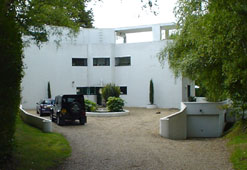


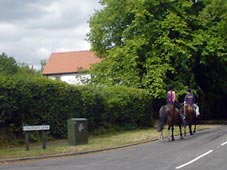 From the station I set off south in search of Sir John's first quarry, a house up Shire Lane named "
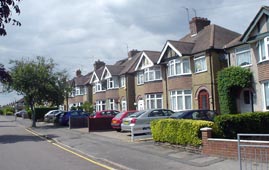

 I'm just pleased that Betjeman filmed Metro-land in 1972, back when I was an anonymous seven year-old obscured somewhere in the crowd. Had he visited a few years later he might have caught me taking a slightly more prominent role. I was never in the running for page boy, thankfully, but in 1976 I was press-ganged into taking part in the
  There is no posher part of Metro-land than Moor Park. You can't tell from the train, because many years ago the residents had the sense to plant a row of trees along the edge of the railway line which now screens their secret splendour from passers by. But alight at the seemingly insignificant country halt